financial lab - pbs nova & wgbh
When Interest Compounds
Check out our other two PBS Nova Labs: Exoplanets, Polar
Most financial literacy programs make the same mistake. They assume that by giving people the right information about how to budget, what interest is and how it works, and how to resolve debt will lead to better decisions and outcomes. Decades of research suggest otherwise.
In a 3rd party, academic white paper produced with Duke University's Center for Advanced Hindsight, the Institute of Consumer Money Management, and PBS NOVA Labs, behavioural science researchers Corey Gelb-Bicknell, Jonathan C. Corbin, and Rebecca Rayburn-Reeves identified the missing layer in nearly every financial literacy program on the market. Beyond conceptual literacy (how compound interest works) and practical literacy (how to set up a savings account) lies a third tier: behavioural literacy. The cognitive habits that help people actually act on what they know. This is the gap the NOVA Financial Lab was built to close. And it is the gap that dynamic interactive design is uniquely positioned to close.
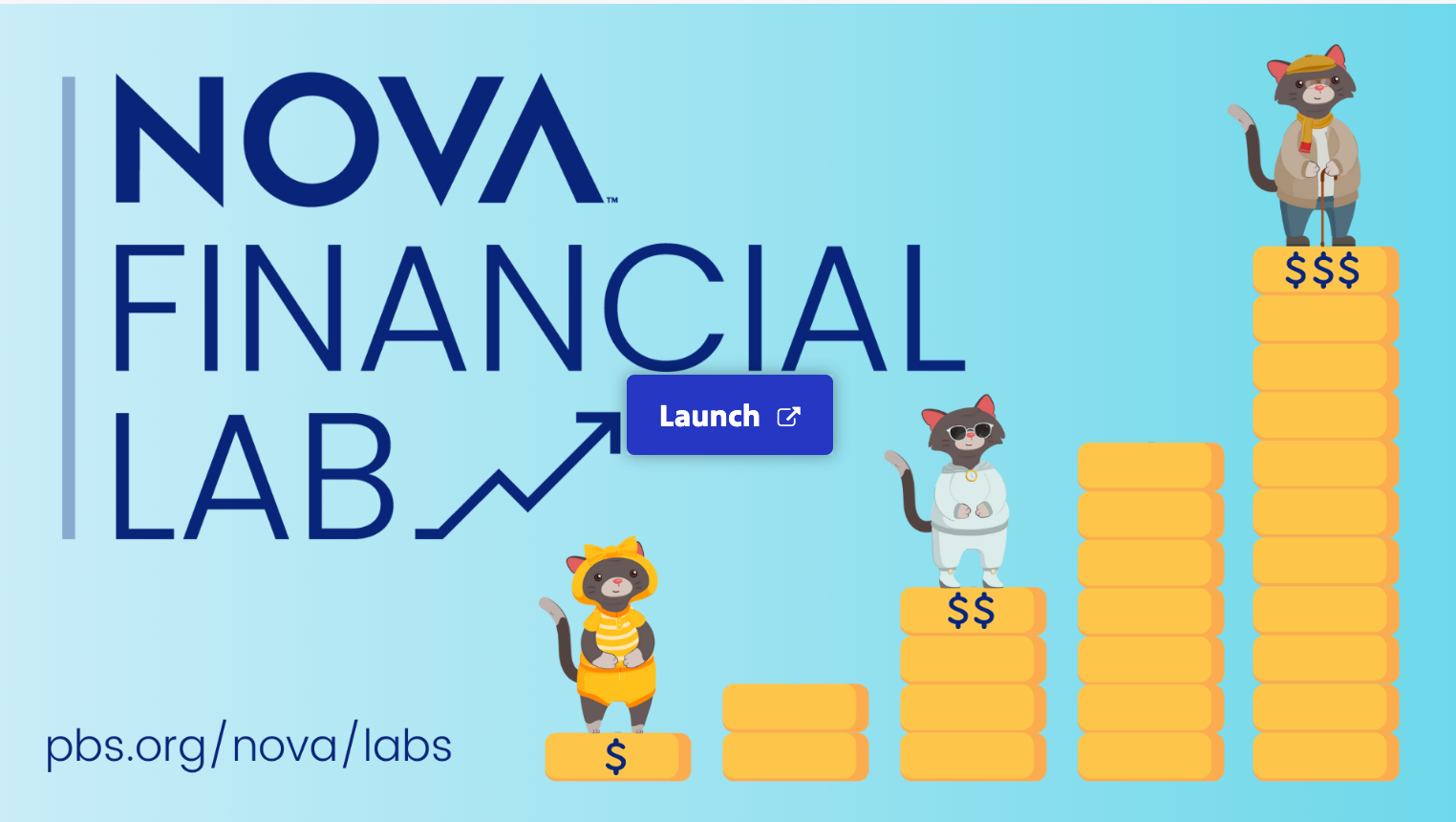
Thought Café partnered with PBS NOVA Labs at GBH Boston for the third time in 2022 to design and animate the Financial Lab, an in-browser game that puts adolescents in charge of a digital pet and walks them through three behavioural mini-games. The result is a financial literacy game designed with rigor and behavioural scrutiny of a published academic paper. The paper captures the core thesis behind the entire design: behavioural science has shown that humans tend to be present-biased, context-driven, forgetful creatures of habit, living in a world that is largely built to take advantage of each of those tendencies.
A well-designed interactive does three things beyond the capability of solely a textbook, or video. It creates a safe rehearsal space for high-stakes decisions. It produces immediate, salient feedback when biases play out. And it lets learners encounter the same principle across varying contexts until the gist sticks. Each mini-game then ends with a just-in-time prompt that translates the lesson into a real-world action.
The work behind the Financial Lab represents what Thought Café does at scale. We build interactives, animations, and learning experiences that begin with a behavioural question. We work alongside academic researchers, subject-matter experts, and behavioural scientists to ensure the design choices we make are grounded in evidence and tested for outcomes. The Financial Lab is one example. There are others across health education, civic literacy, and science communication.